
Martinique
French Caribbean island with volcanic heritage and biosphere reserve status.
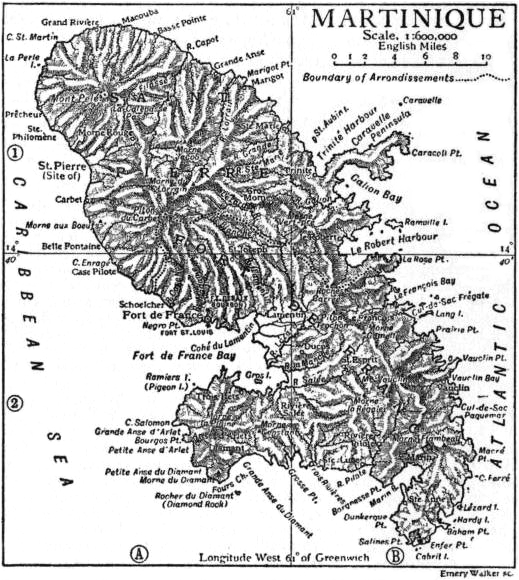
Martinique sits in the eastern Caribbean Sea as part of the Lesser Antilles, within the West Indies. It belongs to France as an overseas department and region, functioning as a single territorial collectivity, and is also part of the European Union as an outermost region. However, it lies outside the Schengen Area and the EU Customs Union, using the euro as its currency. The entire land and sea territory of the island has been a UNESCO Biosphere Reserve since 2021, and in September 2023, the volcanoes and forests of Mount Pelée, along with the peaks of northern Martinique—especially the Pitons du Carbet—gained UNESCO World Heritage Site status.
Covering a land area of [unspecified in source], Martinique had a population of 349,925 as of January 2024. It is one of the Windward Islands, positioned directly north of Saint Lucia, northwest of Barbados, and south of Dominica. Nearly everyone on the island speaks both French—the sole official language—and Martinican Creole.
The name “Martinique” likely comes from a corruption of the Indigenous name for the island, which may have meant “island of flowers” or “island of women,” as relayed by the Kalinago to Christopher Columbus during his 1502 visit. Historian Sydney Daney recorded that the Kalinago themselves called the island “Iouanacaera” or something similar, meaning “the island of iguanas.”
Before European contact, the Saladoid people from the Orinoco Basin in South America settled the island in the 1st century AD, followed by the Kalinago from the Venezuelan coast around the 11th century. Columbus first charted Martinique in 1493 during his second voyage, though he did not land then. He did land on 15 June 1502, spending three days refilling water casks, bathing, and washing laundry. The Indigenous people he met called the island “Matinino” and told him it was populated entirely by women, with Caribs visiting at certain seasons; any sons born were given to their fathers to raise.
Spain ceded Martinique to France in 1635 after 133 years of Spanish rule. On 15 September 1635, Pierre Belain d’Esnambuc, the French governor of St. Kitts, arrived in the harbour of St. Pierre with 80 to 150 French settlers after being driven off St. Kitts by the English. He claimed Martinique for King Louis XIII and the Company of the American Islands, establishing the first European settlement at Fort Saint-Pierre. D’Esnambuc died in 1636, leaving his nephew Jacques Dyel du Parquet as governor. In 1636, the Kalinago rose against the settlers but were repelled and forced to the Caravelle Peninsula. When they revolted again in 1658, Governor Charles Houël du Petit Pré retaliated, killing many and expelling the survivors to Dominica or St. Vincent.
After du Parquet’s death in 1658, his widow Marie Bonnard du Parquet attempted to govern, but King Louis XIV took over sovereignty due to unpopularity. In 1654, Dutch Jews expelled from Portuguese Brazil introduced sugar plantations worked by enslaved Africans. In 1667, during the Second Anglo-Dutch War, Britain attacked the pro-Dutch French fleet in Martinique, nearly destroying it. The Dutch tried to conquer the island in 1674 but were repulsed.
Many early French settlers were Huguenots seeking religious freedom, as there were few Catholic priests in the French Antilles. Others were transported as punishment for refusing to convert to Catholicism, many dying en route. Survivors were industrious and prospered, though some became indentured servants. Edicts from Louis XIV’s court suppressing Protestants were mostly ignored until the Edict of Revocation in 1685. After that, many Huguenot planters plotted to emigrate, encouraged by Catholics eager to seize their property. By 1688, nearly all French Protestants had fled to British American colonies or Protestant Europe, decimating the population and setting back colonization for decades. This led the French king to relax policies in the region, leaving the islands vulnerable to British occupation over the next century. Under Governor Charles de Courbon, comte de Blénac, Martinique served as a base for further French actions.
- location
- Lesser Antilles, eastern Caribbean Sea
- official_language
- French
- currency
- Euro
- status
- Overseas department and region of France
Lore & Background
Martinique is an island in the Lesser Antilles of the West Indies, situated in the eastern Caribbean Sea. It lies directly north of Saint Lucia, northwest of Barbados, and south of Dominica, and is part of the Windward Islands. The island is an overseas department and region of France, and a single territorial collectivity. As a part of the French West Indies, it is also a special territory of the European Union, though it is not within the Schengen Area or the EU Customs Union; its official currency is the euro. The entire land and sea territory of Martinique has been designated a UNESCO Biosphere Reserve since 2021. In September 2023, the volcanoes and forests of Mount Pelée and the peaks of northern Martinique, notably the Pitons du Carbet, were inscribed as UNESCO World Heritage Sites. The island has a land area and a population of 349,925 inhabitants as of January 2024. Virtually all residents speak both French, the sole official language, and Martinican Creole. The name "Martinique" is thought to derive from an Indigenous term meaning "island of flowers" or "island of women," as relayed to Christopher Columbus by the Kalinago people. The Kalinago themselves reportedly called the island "Iouanacaera," meaning "the island of iguanas." The island was first occupied by the Saladoid people from the Orinoco Basin in the 1st century AD, followed by the Kalinago from the Venezuelan coast around the 11th century. Columbus charted the island in 1493 and landed there in 1502. After Spanish rule, France formally took possession in 1635, establishing the first European settlement at Fort Saint-Pierre. Sugar plantations worked by enslaved Africans were introduced by Dutch Jews expelled from Portuguese Brazil in 1654.
Reader's Guide
Martinique’s significance is rooted in its long colonial history under France and its pivotal role in the Atlantic sugar and coffee trades, which were built on enslaved African labor introduced by Dutch Jewish planters expelled from Brazil in the mid-17th century. The island’s cultural identity is a blend of French and Creole heritage, with nearly all inhabitants speaking both French and Martinican Creole. Ecologically, Martinique is notable for its volcanic and forested landscapes, including Mount Pelée and the Pitons du Carbet, which were designated UNESCO World Heritage Sites in 2023. The entire land and sea territory has been a UNESCO Biosphere Reserve since 2021, underscoring its biodiversity. Historically, the island was first inhabited by the Saladoid people from the Orinoco Basin around the 1st century AD, followed by the Kalinago from the Venezuelan coast in the 11th century. Christopher Columbus charted it in 1493 and landed in 1502, encountering Indigenous people who called it “Matinino.” French colonization began in 1635 under Pierre Belain d’Esnambuc, leading to conflicts with the Kalinago, who were eventually expelled. The island’s economy and society were deeply shaped by plantation agriculture and the transatlantic slave trade, with Huguenot settlers also playing a role before many fled after the 1685 Edict of Revocation. Martinique remains an overseas department and region of France, using the euro, and is part of the European Union as an outermost region.
Did You Know?
- Martinique is thought to be a corruption of the Indigenous name Madiana or Madinina, meaning 'island of flowers'.
Geography, Political Identity & UNESCO Recognition
Martinique sits in the eastern Caribbean Sea as one of the Windward Islands in the Lesser Antilles, positioned directly north of Saint Lucia, northwest of Barbados, and south of Dominica. It functions simultaneously as an overseas department and region of France, a single territorial collectivity, and an outermost region of the European Union within the European Economic Area's special territories. Yet it falls outside both the Schengen Area and the EU Customs Union. The euro serves as its currency. Linguistically, virtually the entire population is bilingual in French—the sole official language—and Martinican Creole.
Indigenous Roots & the Island's Many Names
Long before European ships appeared on the horizon, Martinique was home to successive Indigenous communities. The Saladoid arrived from the Orinoco Basin in South America during the first century AD, followed around the eleventh century by the Kalinago, who came from the Venezuelan coast. The island's very name carries echoes of these early peoples. These layered names and stories anchor the island's identity far beyond its French colonial narrative.
Colonial Foundations & the Huguenot Tragedy
That September, Pierre Belain d'Esnambuc—driven off St. Kitts by the English—landed at St. Vincent. Among the earliest settlers were many Huguenots seeking religious freedom, some of whom had been transported as punishment for refusing Catholic conversion.
A Crossroads for Pirates & Privateers
Martinique's strategic position in the Caribbean made it a magnet for maritime adventurers. Under Governor Charles de Courbon, comte de Blénac, the island served as a home port for French pirates, including Captain Crapeau, Étienne de Montauban, and Mathurin Desmarestz. The island's name even appeared on the flags of notorious buccaneers. These episodes underscore how the island's harbor and its position among the Windward Islands made it a crossroads where colonial authority, privateering, and the brutal economics of the slave trade all intersected in the early eighteenth century.
Gallery
More in Islands And Archipelagos 1-24
Spotted an error? Know more?
This is a living reference — every entry is fact-audited, and reader corrections feed straight into our audit queue. Suggest an edit · See this site's audit record